
Your rose plant care guide
Surprise surprise – we love a rose. But we don’t think they should only be enjoyed in a vase, or outdoors in a garden. Enter our rose plant. Dotted with mini colourful blooms, it’s just the thing. Want to know how to keep yours looking its best for as long as possible? Keep reading.
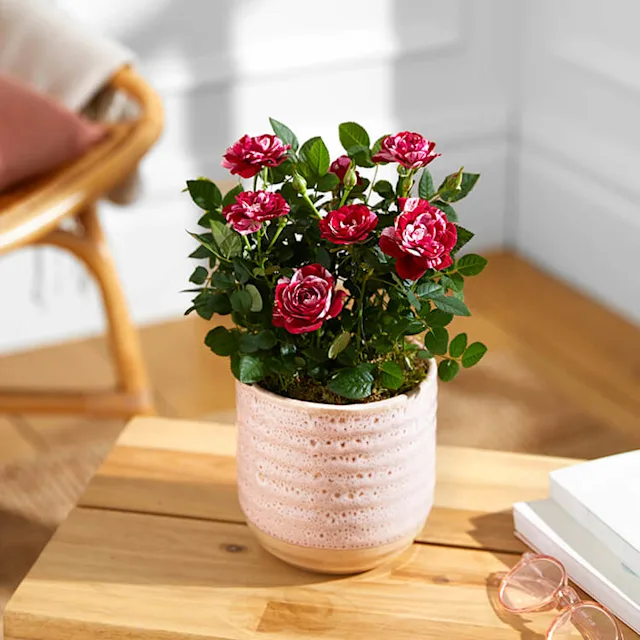
How to care for a rose plant
Pop it in a really sunny spot
Like most other flowering plants, rose plants need plenty of sunshine to produce blooms. At least six hours of direct sunlight is best. So place yours by your sunniest window.
Give it a drink weekly
Growing flowers is thirsty work. Make sure yours gets enough water by giving it a good drink every week – or twice weekly if it’s particularly warm. Focus the water on the soil rather than the blooms or the leaves, as this could cause fungus to grow.
Fertilise it every month
Fertiliser will help your plant thrive. Get some that’s specially formulated for roses and mix it into some water every four to six weeks, during growing season (March to September). Use one that’s balanced to ensure it gets all the nutrients it needs.
Prune at the very start of growing season
It’s best to prune your rose plant in spring while it’s still dormant, as this will encourage new blooms. Use clean, sharp scissors or shears to remove any wilted blooms or leaves.
What are the signs of an unhappy rose plant?
Yellow leaves
This may be caused by a few different things. The first is overwatering. Try reducing how often you water the plant (or how much water you give it). Check how many drainage holes your pot has too. If the water isn’t allowed to run off, the soil will get too damp.
If water isn’t the problem, increase how often you’re fertilising your roses. Lastly, you could try moving the pot somewhere that gets more sunlight.
Wilting leaves or blooms
Again, this could be caused by an inconsistent watering schedule. Water your plant weekly (or slightly less frequently during summer). Damp soil can lead to root rot.
Spotted leaves
Your plant could be suffering from black spot or powdery mildew. Treat it by removing any affected leaves and applying a fungicide specially formulated for roses.
Remember, only water your rose plant’s soil. Getting moisture on any other part of your plant can lead to diseases.
Little growth
Rose plants need plenty of sunshine to grow well. So make sure it’s in a spot that gets at least six hours of direct sunlight. You may also need to increase how often you fertilise it.
Bugs
Watch out for aphids, spider mites, and Japanese beetles. These pesky bugs love roses as much as we do. To get rid of them, grab some non-toxic insecticidal soap or neem oil and dilute it with some water. Dab a cotton bud in the mixture and gently rub it anywhere you notice the bugs, including the underside of the leaves (where they like to hide!).
Do I need to repot my rose plant?
Rose plants don’t need to be repotted often. But they’ll appreciate some fresh soil every three years or so.
The best time to repot your plant is at the start of spring while they’re still dormant.
1. Choose a pot with drainage holes that’s slightly larger than the current one. Then fill the bottom of the pot with a layer of well-draining potting mix.
2. Remove your rose plant from its original pot by gently tipping it on its side and gently pulling it out by its base. Be careful not to damage any blooms.
3. Pop your plant in the centre of the new pot and fill around its roots with the new potting mix, pressing down gently to remove air pockets.
4. Finish by lightly watering the soil.